
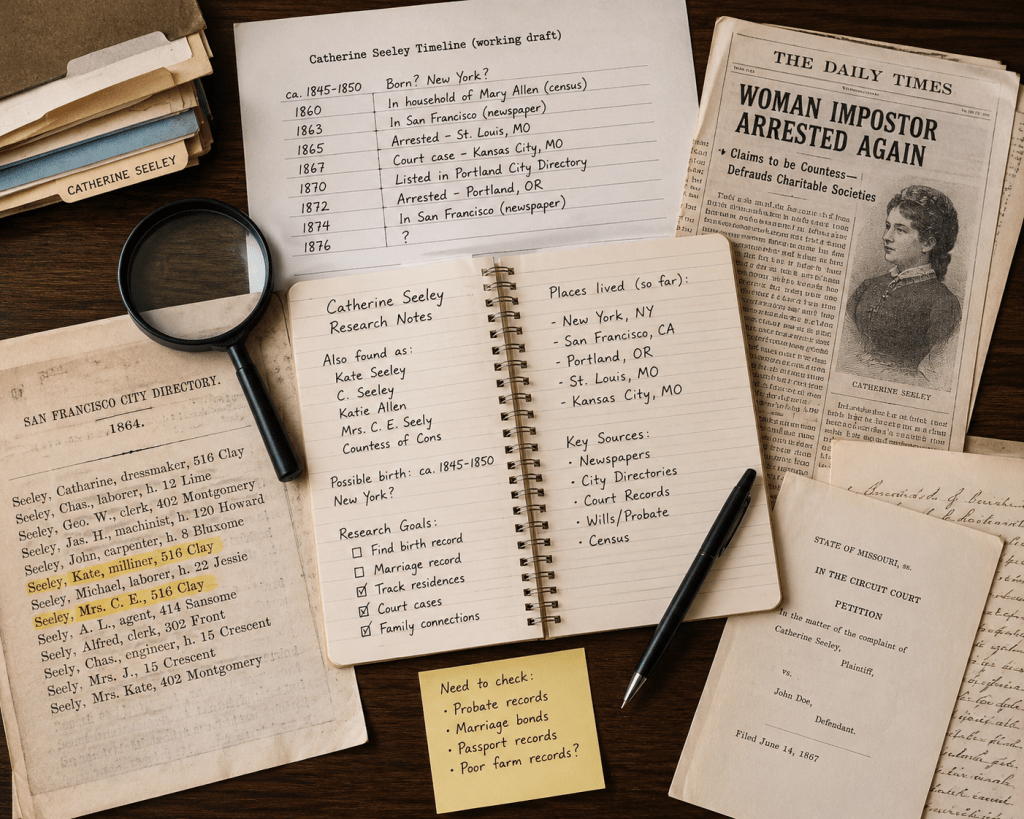
Genealogists love a good mystery. Over the past several years, I’ve been researching Catherine Seeley, the remarkable woman at the center of my upcoming narrative nonfiction book, Countess of Cons. At first glance, Catherine seemed like the easiest historical figure a researcher could hope for.
She appeared in hundreds of newspaper articles across multiple states. Reporters eagerly documented her arrests, court appearances, charitable schemes, and ever-changing identities.
The problem wasn’t finding Catherine.
The problem was proving who she really was.
Despite all those newspaper accounts, some of the records genealogists rely on most remain frustratingly elusive. I have never found a verified birth record. No marriage certificate has surfaced. Even the basic milestones of her life had to be reconstructed from court records, city directories, census schedules, newspaper accounts, and countless other sources.
Researching Catherine taught me an important lesson: the loudest historical voices aren’t always the most reliable. Sometimes the real challenge isn’t locating a person—it’s separating fact from fiction.
Following her story taught me several lessons that apply to almost any family history project.
1. Women often changed more than their surnames.
Most genealogists expect a woman to change her surname after marriage. Catherine reminded me that some people changed much more than that.
She frequently used aliases and altered details about her past to suit her circumstances. If I had searched only one name, I would have missed large portions of her story.
Sometimes the person you’re looking for is hiding in plain sight under a different name.
Research Tip: Search every reasonable variation of a name, including first and middle names, nicknames, initials, maiden names, and common misspellings. You never know which version a record keeper—or newspaper reporter—used.
2. Newspapers are wonderful—but they aren’t always right.
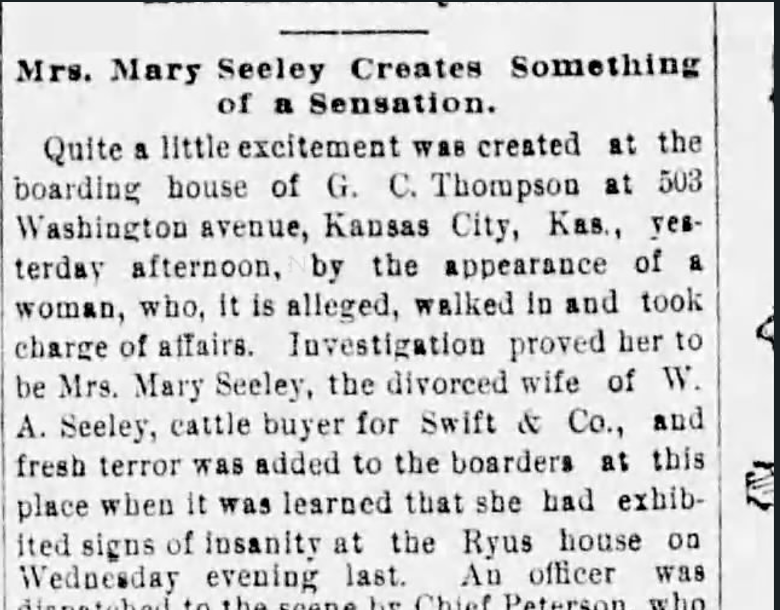
Catherine’s name was reported as “Mary”
Newspapers have been among my richest sources, but they have also been some of the most frustrating.
Reporters misspelled names. Ages changed from one article to the next. Places were confused. Occasionally, different newspapers reported the same event with completely different details.
Rather than accepting every article at face value, I learned to compare multiple accounts and ask, “What facts do they all agree on?”
Research Tip: AI (artificial intelligence) can be a wonderful research assistant. It can quickly transcribe difficult newspaper articles, compare multiple accounts of the same event, and help identify inconsistencies that deserve a closer look.
3. Court records are treasure chests.
Newspaper stories often tell us what happened.
Court records frequently explain why.
Petitions, testimony, legal filings, wills, and judges’ decisions can reveal relationships, motivations, financial circumstances, and details that never appeared in print. In fact, it was the will of Catherine’s mother, Mary Allen, that provided the clue that finally untangled one branch of Catherine’s family.
Research Tip: Treat newspaper accounts as leads—not conclusions. Follow every court case into the courthouse whenever possible.
4. Never underestimate the humble city directory.
City directories became some of my favorite research tools.
Unlike the federal census, which appears only every ten years, directories can track a person’s movements year by year. They helped me determine where Catherine lived, whether she had moved, and sometimes even what occupation she claimed at the time.

Those small details often became the missing pieces that connected larger events.
Research Tip: City directories can do much more than provide addresses. They’re invaluable for filling the gap left by the lost 1890 census and for tracking a family’s movements year by year. Pay attention to changes in addresses, occupations, and household members—they often point to the next record you need.
5. Don’t stop with the first answer.
This may be the most important lesson of all.
More than once I thought I’d solved a mystery—only to uncover another record that forced me to rethink everything I thought I knew.
Sometimes the most important clue isn’t the record you find—it’s the record that should exist but doesn’t.
Genealogy rewards curiosity. Every new discovery should prompt another question rather than signal the end of the search.
The deeper I dug, the more complete Catherine’s story became.
That’s one of the reasons I enjoy genealogy so much. Every document is a clue, every clue opens another door, and sometimes a single forgotten newspaper clipping—or a missing birth record—can reshape an entire story.
Research Tip: Every answer should lead to another question. If the record you expected isn’t there, don’t assume the trail has ended. Ask why it’s missing, then look for alternative sources that might tell the same story.
Have you ever researched someone who seemed to leave a trail everywhere—except in the records you actually needed?
 Who We Are and How We Got This Way
Very good points, Catherine lived in a time when official records weren’t always mandatory, weren’t always filed, weren’t always accurate even when submitted on time, and even when records were filed, they may no longer exist today. I can’t wait to read more about this notorious con artist!
LikeLike