
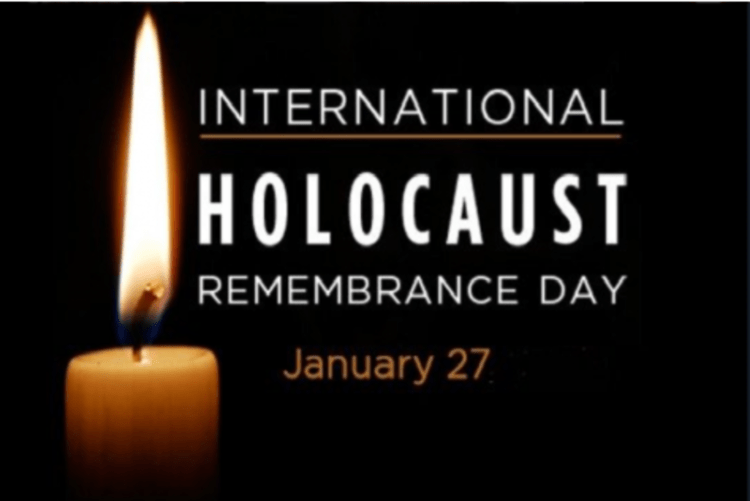
Today, January 27 is International Holocaust Remembrance Day—the 80th anniversary of the liberation of the Auschwitz concentration camp. Last year, at this time, my novel Nothing Really Bad Will Happen had yet to be released. This year, I marked the day (a few days early) by bringing my 9-year-old granddaughter, Paisley, to the Woodbury Public Library to view the display I put together in honor of the day.
I wrote about the display in detail on my book blog: nothingreallybadwillhappen.com. Today, I want to share my experience in relating this important family story to my granddaughter.
Paisley knew who Hitler was—”a bad guy who didn’t like Jewish people.” But she didn’t know many of the details. It’s always a delicate balance, deciding how much to share with children about the terrible things humans have done to one another—especially with a child who often worries about how the events of the world might affect her own life. So we have tread lightly the past year in describing what my book was about.
Today I decided she could handle a little bit more. We walked over to the display and I let her just look at it for a while. Of course, at first she was more interested in showing off her new stuffed kitty!
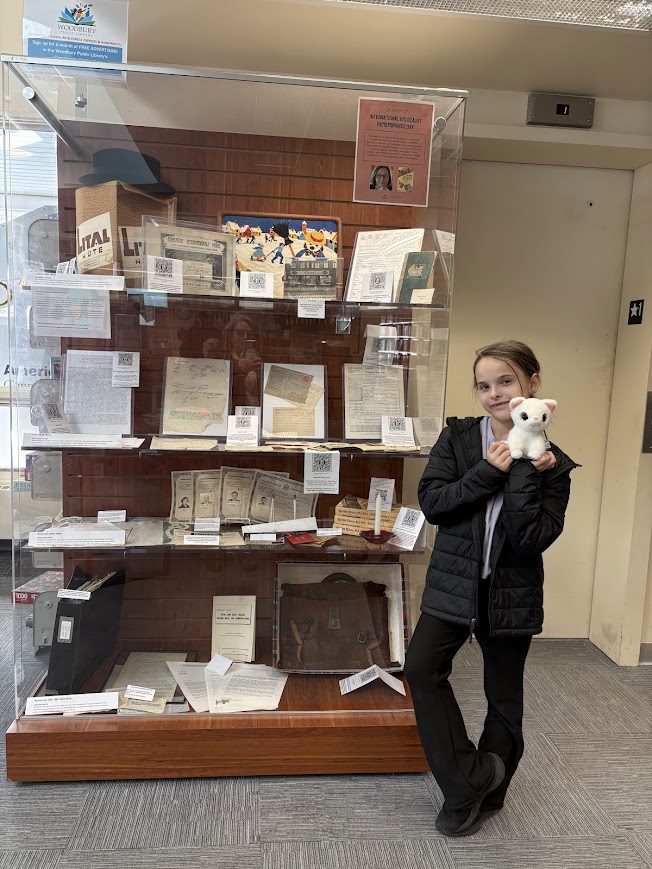
Each shelf represents an era in my family’s Holocaust story.
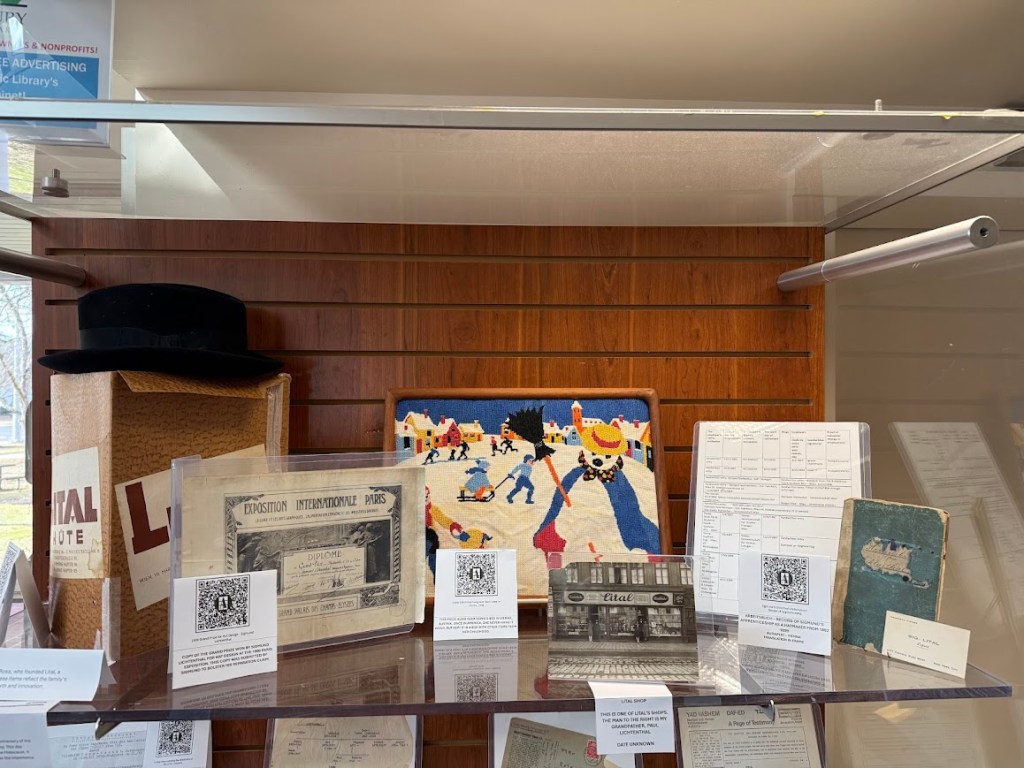
The LEGACY shelf features items connected to the establishment of my great-grandfather Sigmund Lichtenthal’s hat business, LITAL, in Vienna, Austria. It also includes a framed embroidery that once hung above my mother’s bed as a child in Vienna in 1938.
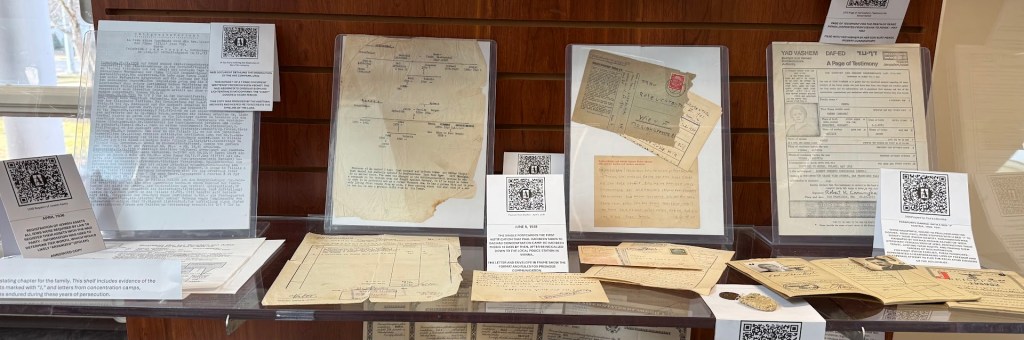
The items on the LOSS shelf include the personal inventories the Jews were required to file in 1938, a New Year’s coin from 1938 (considered a Good Luck charm), letters written by my grandfather Paul Lichtenthal from Dachau and Buchenwald, a copy of a page of testimony from Yad Vashem remembering the murder of my great aunt Renee Mendel at a camp in Minsk in 1942, and my grandfather Paul’s passport with the red “J” stamped on it. Also on this shelf is a copy of the 1938 daily journal of the Nazi assigned to liquidate my great-grandfather’s business.
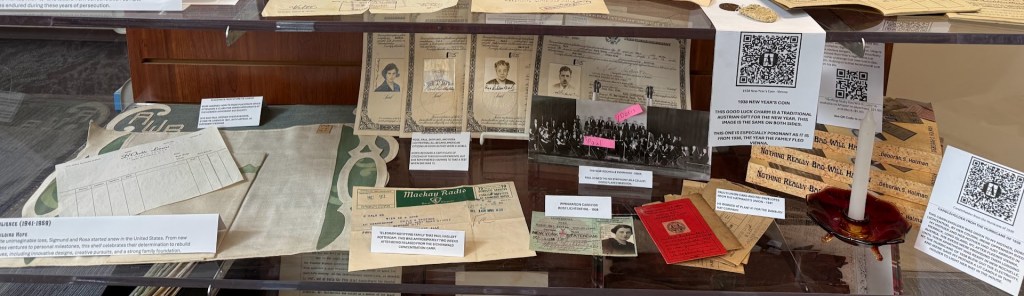
The RESILIENCE shelf holds items dating back to 1938, the year my mother arrived in New York with her mother. They stayed with family for a time, and during the Great Hurricane of 1938, when the lights went out, my mother’s cousin Irene handed her a lit candle in the orange candleholder you see on the shelf. My mother cherished it for the rest of her life. Also on that shelf are items representing the family’s ability to start over in their new country: naturalization certificates, the Hat Maker’s Union Member’s card of my grandfather Paul from the Danbury Hat Factory, a telegram announcing Paul’s departure from Vienna in 1939, and a Plexon placement from the company my grandmother founded in the 1940s (named D’Orette in honor of my mother, Doris.)
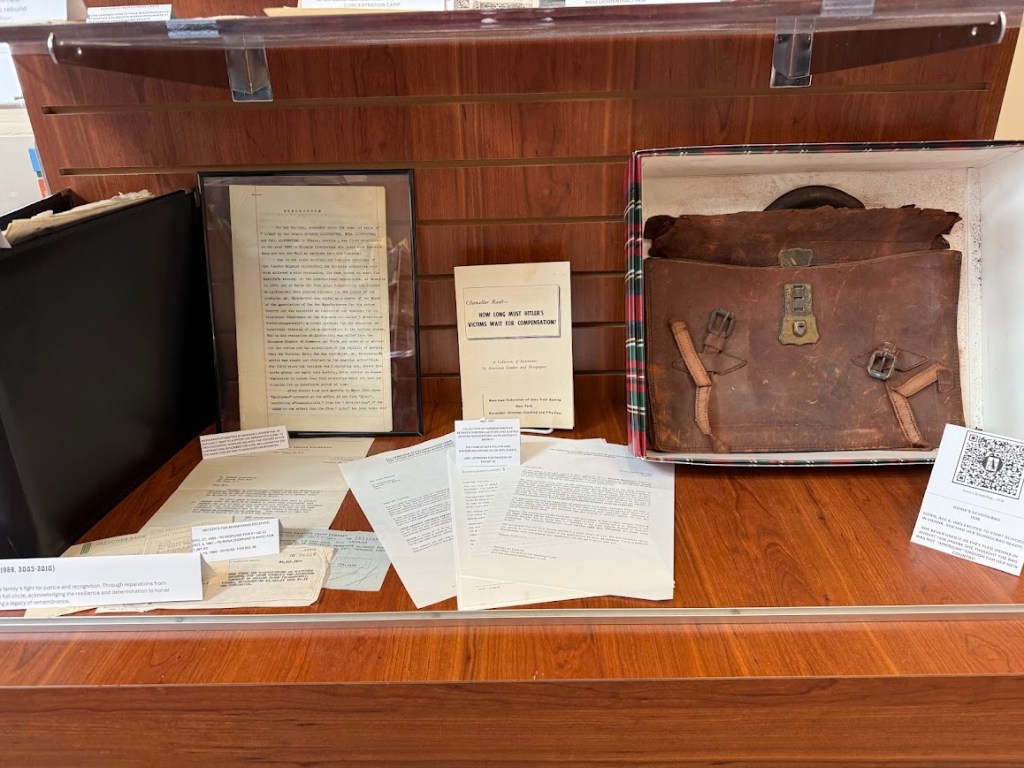
Most of the items on the REPARATIONS shelf relate to the efforts made by my great-grandfather and grandfather to obtain reparations for their losses. From the moment he was forced to sign his business over to the Nazis, Sigmund never gave up. He died in 1957, having only minimal success; approximately $1700 in compensation for the loss of one hat factory and five shops. My grandfather died in 1959 of a sudden heart attack (partially caused by the damage sustained in the concentration camps.) His compensation consisted of $150 – $15 for each of the 10 months spent in Dachau and Buchenwald. Also on this shelf are documents related to the reparation claim I submitted in 2003 on behalf of my mother. She died in 2011, one year after receiving the last of the reparation checks that provided her enough money to remain in her home. The battered leather case (which didn’t fit on any of the other shelves) was my mother’s schoolbag. Her parents gave it to her in 1938 in anticipation of going to school. She never used it. By the time school started in September 1938, six-year-old Doris was thousands of miles away from her home in Vienna, waiting to start a new life in America. The bag went into a box, into a closet, and became another reminder of the life she had lost.
So, back to Paisley. The first thing she asked was, “Who are all those people?” (on the naturalization certificates) so we had a conversation about what people needed to do to become citizens in a new country.
Paisley has some sort of “cosmic connection” with my mother, who she calls “Great Omi” (I am regular Omi!) so she was interested to learn my mother had to take a test in order to become a citizen. She also asked about the red card on the resilience shelf. Probably because it was bright red! It surprised her to learn that great-Omi’s father made hats in Danbury (a town near us that she is very familiar with.)
Of course she asked about the hat and hatbox. I was happy to explain that her great-grandfather made hats and built a big hat company, even winning the Grand Prize at the Paris World’s Fair.
I was a little unsure how to proceed when she asked about the Page of Testimony (but happy for the opportunity). I explained that Great Aunt Renee was taken to live in a terrible place and that many Jewish people were forced to do the same thing. I told her Renee had died there and so did many other people. The Page of Testimony is something that is filled out about the person who died and saved in a special place so that they will always be remembered.
At that point, she had had enough and was ready to go upstairs to pick out a book. But first she wanted to see my book on the library shelves. (Honestly, so did I!) So we went to the computer to determine the location. The book was CHECKED OUT! I must admit that was a huge surprise—and it sure felt great!
I took that opportunity to tell Paisley that one of the reasons I wrote the book was not just so people could learn about what happened during that terrible time, but that they could see how our family overcame the struggles and made new lives for themselves. I told her it’s important for people to remember what happens in history so they don’t repeat the same mistakes. (Omi trying to be hopeful in 2025!) Her response? “I really like learning about history and what happens.” With that we climbed the stairs to the children’s section on the second floor.
We enlisted the help of the wonderful children’s librarian to suggest some books. After choosing a Harry Potter tome and a book from the “I Survived…” series, Paisley told the librarian she liked history and wanted to learn about the Holocaust. The librarian directed us to the “Dear America” series, where we discovered One Eye Laughing, The Other Weeping: The Diary of Julie Weiss. The fictional book, based on real events, is the diary of young girl who left Vienna in 1938 and went to New York. Exactly like Paisley’s Great Omi did! (Of course, I’m thinking my mother orchestrated that whole thing!)
“I’m not sure what Paisley took away from our visit with her family’s past, but I do know she is a thinker. She will remember our day, and I’m certain the topic will resurface. I must admit, I’m proud of this little girl who truly understands the importance of treating people equally. When I asked her what she thought about how Hitler treated the Jewish people just because they were Jewish, she said, “I don’t think you should treat people differently because they look different or think different. You can think one thing, and they can think another. You can still be friends.” From your lips to God’s ear, kid.
 Who We Are and How We Got This Way
Paisley sounds wise beyond her years. Your library exhibit is very well done, especially the idea of representing the themes of legacy, loss, resilience, and reparations. Never again, never forgotten.
LikeLiked by 1 person
This is particularly relevant in our current time. As a retired high school history teacher, I always felt the struggle between “covering the curriculum” and “teaching history” — they’re not the same thing. Teachers can’t do it all. Librarians and Family members like you help fill this gap. Thank you.
LikeLike
Another great story!!!! Well, you know what I mean!
LikeLike
Paisley is so lucky to have you as her grandmother!!! Beautifully expressed and wh
LikeLike
It sounds like you hit a good balance in describing everything to Paisley. And the display is a wonderful vehicle to share your story.
LikeLike