
I’m tired. My brain is moosh. I slept in and skipped my 8:30 session. Therefore, the first session I attended today was Adina Newman’s hands-on computer workshop about using Holocaust resources. Yes, I have used many, many resources during my research for the book, but there is always something new to learn, right?
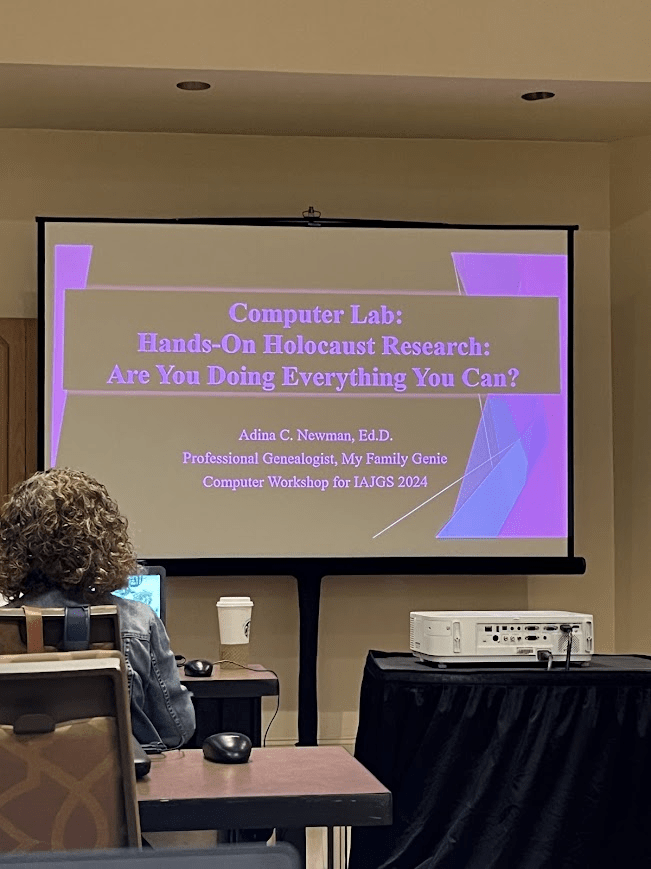
What I really liked about this session was how Adina very methodically listed a variety of resources and then gave tips for using each one. There was nothing new for me there, but I created a very nice list which I will share in a future issue of Quest, JGSCT’s quarterly newsletter. I did learn about one new resource, which might have some value in the future – a Russian website (use Google translate!) that lists Russian soldiers. I can’t remember how to say the name, but click here to link to it.
After that session, I reheated my French Dip sandwich from two days ago for lunch. I hope we go somewhere good for dinner; it was quite unsatisfying! I spent the next little while catching up on yesterday’s blog, and then headed to Mindie Kaplan’s session about Unusual Resources. I was looking forward to learning about some new things. Too bad for me. Cancelled! Maybe that’s a sign to give my brain a rest. I headed back to my room where I am now writing this post! Oops – time to go! Next up:
Born to Be Filed: A Story of Civil Birth Registration in the United States.
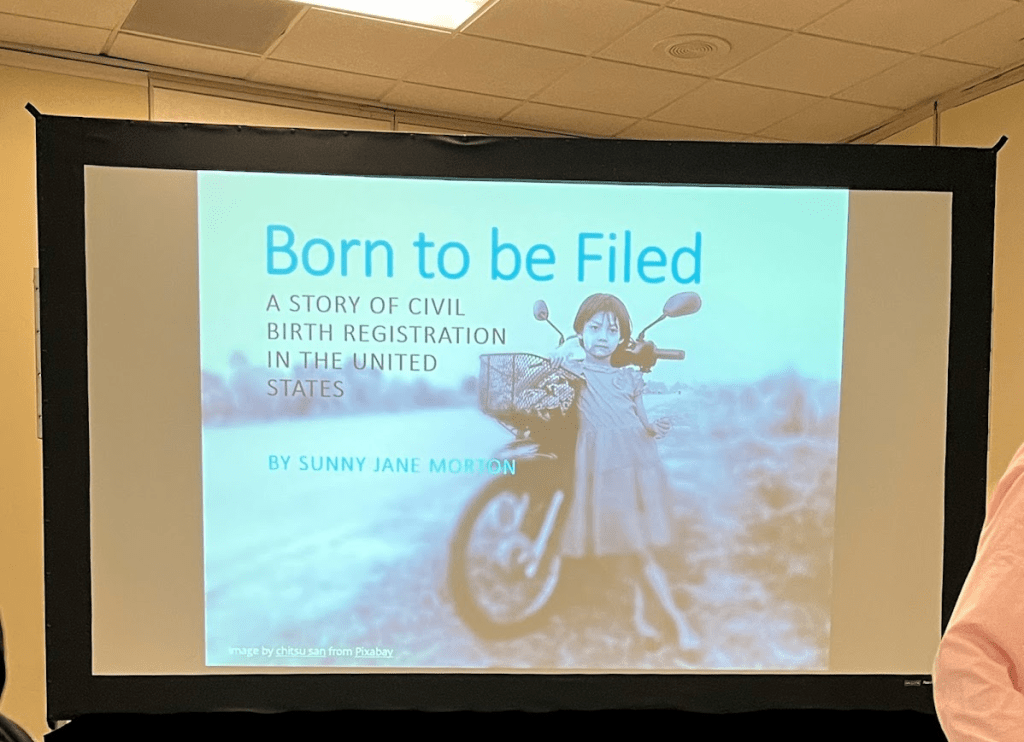
Sunny Jane Morton presented the history of how civil birth registration came to be in this country. Her presentation was extremely informative as well as humorous. I really enjoyed learning the history as Sunny used clips from newspaper articles to clearly illustrate the social issues of the times.
Civil registration began in response to public concerns about tracking data regarding infant mortality. Until social programs such as Social Security began, and the need to prove citizenship in order to obtain a government job during WWII, people were slow to respond to laws requiring birth registration that began, in some places as early as the 1860s. A newspaper article from 1930 stated 60,000,000 Americans couldn’t prove their prove their birth.
Sunny used Ohio as an example of how the requirements to register birth evolved, as well outlining some of the issues that resulted in people not registering, despite it being law.
She explained that when people completed a “delayed report of birth” there was no uniform method to do so. In addition, these forms are often filed with court or county records rather than with the birth records, which may account for why a person’s report of birth may not be found. Sunny suggested using search terms such as “delayed birth” or “corrected birth record” to find these records in the catalogs of the larger genealogy databases.
Another tip was to check local newspapers to search for reports of birth. I particularly liked her TAKE-HOME TIP about researching a specific type of record:
Learn its history – Find the laws governing it – See public discussions about it
Sunny Morton – IAJGS 2024
Good advice for any genealogical search, I would say.
We had nothing planned for the evening, so we joined two friends for an early dinner at an Indian restaurant. I was in bed by 7:30 to finish this post. It’s now 8:30 and I’m ready for sleep! Last day tomorrow!
 Who We Are and How We Got This Way
Whew, what a conference! And as it happens, my hubby’s grandmother was born in Ohio before required birth registration but when it came to Soc Sec, she filed a delayed birth registration with witnesses (her older sisters) to prove her age!
LikeLiked by 1 person