
As the publication of my novel, Nothing Really Bad Will Happen draws closer, I have been reflecting on my religious journey. It has been a strange experience over the last several years, spending almost every day in the world of Jews, while not truly having a good grasp on what it means to be Jewish.
I am Jewish. 100% Ashkenazi Jew, in fact. But I have never celebrated Hanukah. I think I’ve attended exactly one Seder in my lifetime. Perhaps it is more accurate to say I am “Jew-ish.” Partly for my descendants and partly for myself, I am going to take this opportunity to chronicle my religious experiences over the past 69 years.
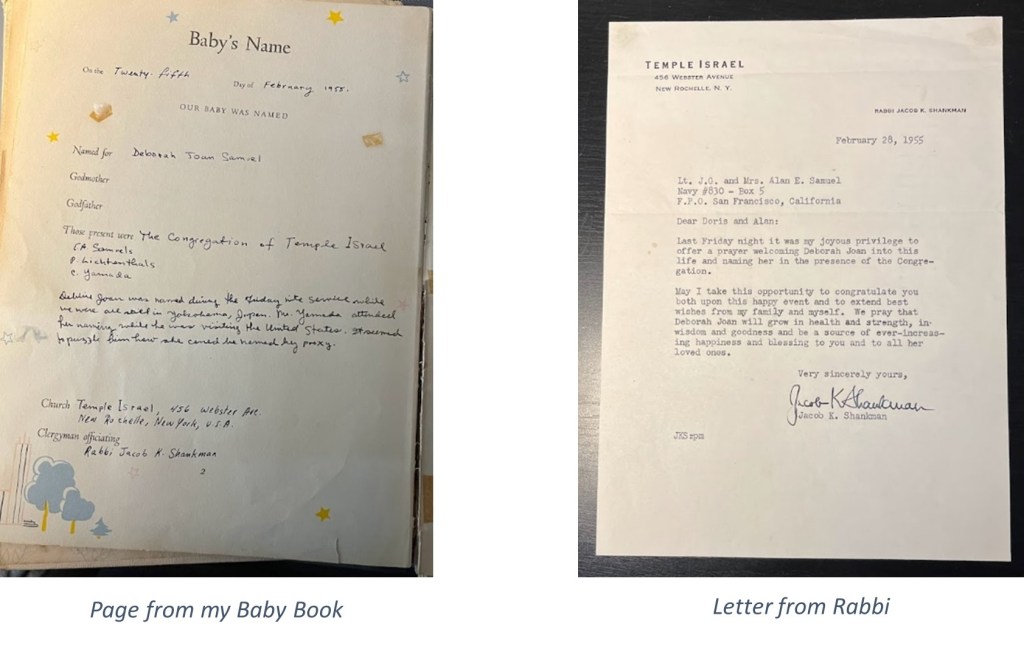
I was born in 1955 to Doris Lichtenthal and Alan Samuel. Both my parents were Jewish; my mom was confirmed at 13 and, while my father did not have a Bar Mitzvah, his parents were active in their local Reformed temple. Interestingly, both sets of grandparents celebrated Christmas. My mother, who was born in Vienna, Austria, explained it was more of a “secular holiday” for them. I never asked my father, but I imagine the answer would have been similar for his family, who hailed from England and Germany.
My name is Deborah, already a Hebrew name, so that’s what is recorded on my naming certificate. As a young child, I have memories of attending Sunday School at Mishkan Israel, the Reformed temple in Hamden, Connecticut. I have no memories of observing the faith in any other way—no Hanukah, no Passover, Rosh Hashanah, or Yom Kippur services. But there was matzoh—and matzoh ball soup! I knew we were Jewish, but I never questioned why we celebrated Christmas to the exclusion of the Jewish holidays. One of my favorite early memories was watching a car arrive at our house on Christmas Day. It was probably 1960 or so. The car door opened, and the skinniest Santa I ever saw emerged. Pop-Pop, my paternal grandfather, had dressed for the holiday!
The only other Jewish family in the neighborhood was Conservative. While they weren’t strictly kosher, they didn’t mix meat and dairy. My mother had to explain to me why that was. They were the extent of my early interactions with other Jews once we no longer attended synagogue.
In 1962, when I was seven years old, my parents divorced. My mother tried to maintain membership in Mishkan Israel; even working in the library to help defray costs, but it quickly became too much of a financial burden.
Soon after my parents’ divorce, my mother met my future stepfather, Alphonse Falcone. “Alfie” was raised Roman Catholic but did not practice his faith. Perhaps the fact he was separated from his wife and seeking divorce had something to do with that. Once he joined the household, our life took on a decidedly different flavor. Literally. Pasta, pizza, and Italian bread soon became my favorite foods. I often say I am Italian “by osmosis.”
The long summer months with five children under the age of ten must have taken a toll on my mother. Mom got a break for one of those months when my father would take my three sisters and me to Vermont or New Hampshire, leaving her to enjoy the relative quiet with her husband and their young son. But she still had to keep us busy for the other month. Her solution—Vacation Bible School. Despite not actively observing her religion, Mom truly wanted us to have to have some knowledge of the bible. So—off to the local Baptist church we went. I don’t remember much about the experience at all. One would think exposure to all the stories of the New Testament and the zealous excitement of the Baptists would have made some impression on me. But no.
What did make a lasting impression was my experience in Pioneer Girls—the Christians’ answer to the Girl Scouts. I was barely ten years old when my mother first sent me. I remember little about what we did during the afternoon programs, but one memory still haunts me to this day.
Over several meetings, the leader encouraged me to “accept Jesus as my Savior.” Every time she approached me, I found a way to wriggle away. However, that one day, for reasons I no longer recall, I said it. I said, “I accept Jesus as my Savior.” I immediately regretted it. I knew they were just words, but I felt like I had just turned my back on something important. I still feel guilty.
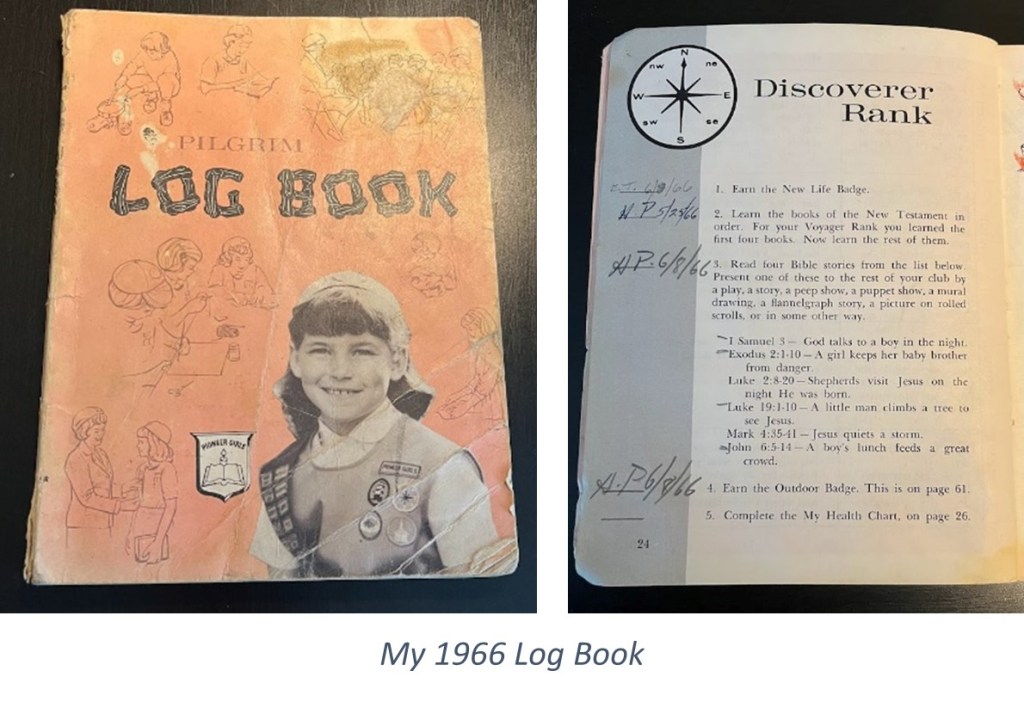
Shortly after that, I stopped attending Pioneer Girls, and my religious education came to a standstill. Until high school. Like most teenagers, I was searching for something to give me a sense of belonging. I wasn’t an athlete or connected with any organized activity. Everyone knew who I was, though. Not because I stood out in any way, but exactly the opposite! I stood out because I was the shortest kid in school. Not exactly the identity I was searching for.
So, when my only Jewish friend (Yes, the one from the neighborhood!) suggested we try joining Mishkan Israel Temple Youth (MITY). I agreed. I remember exactly two things about that experience: Each meeting started by singing, “Announcements, announcements, a horrible way to die. A horrible way to be talked to death…” Seriously. Weird, right? The other thing I remember is always feeling like I was a square peg trying to shove myself into a round hole. All the other kids seemed to have something that bound them together. They also seemed to have money. Something my neighborhood friend and I did not.
After a few uncomfortable meetings, I had a conversation with my mother. I think I was looking for permission to give up on my quest to be a “real” Jew. The day she came to pick me up and saw us all lying around on the platform of the temple’s altar, she gave it to me. For some reason, that appalled her, and she told me I wouldn’t be going back.
You know the saying “If you remember the 60s, you weren’t there?” That applies to the 70s as well. I attended a fairly progressive high school. We had a smoking area outside the cafeteria at the back of the school, but there were always kids laying on the front lawn, smoking grass of a different kind than that on which they were reclined! Surprisingly, this was largely ignored by the administration. At least, from what I could see.
I was a boring kid. A goody-two shoes, some might say. Marijuana was definitely illegal. Only the kids in the Drama Club used it. Oh, and the kids in the Folk Music Club… and probably every kid who felt disconnected but was not afraid of getting caught like I was. The pressure to imbibe was annoying.
Upon entering college, with the freedom that provided, I encountered frequent instances where I was offered various substances to experience. In 1973 one could drink legally at the age of 18. But I had no interest in that. I was partly afraid of being drunk, but mostly, I simply didn’t want to spend my limited funds on something that I likely would “evacuate” from my body within hours. (Note: this opinion changed once I met my future husband at a local bar!)
I may have been a goody-two shoes, but I also was fairly meek when it came to sticking up for myself. So, when a friend of mine told me that the new religion she just joined prohibited the use of drugs and alcohol, I saw a solution. Once I joined her and became a Baha’i, it was so easy to say, “Oh, sorry I can’t. It’s against my religion.” Problem solved.
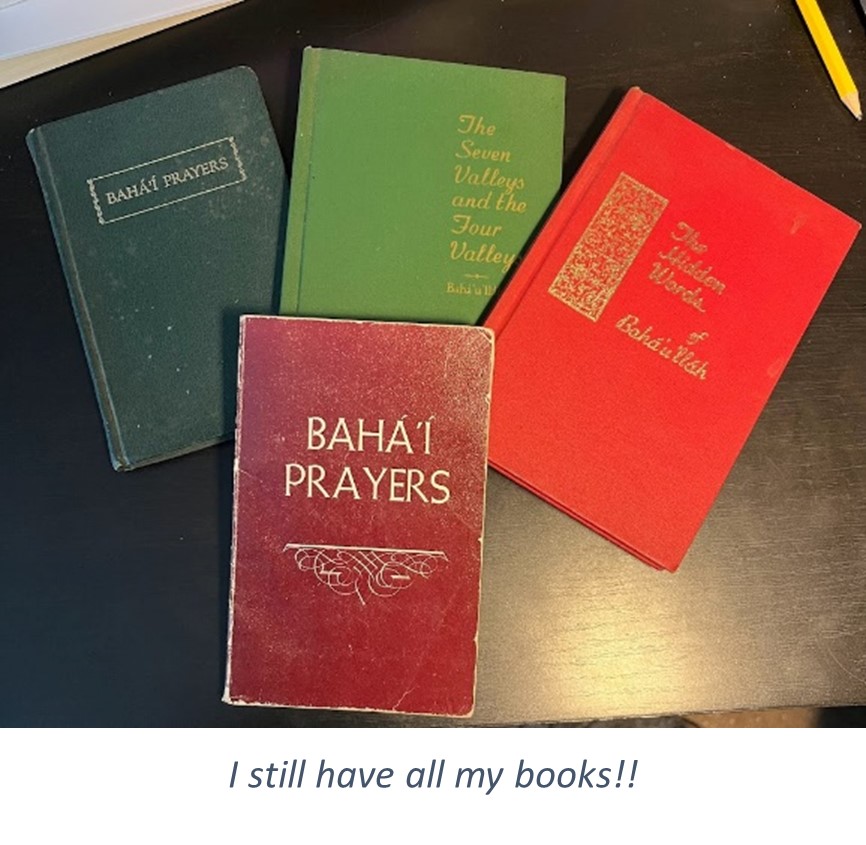
I actually loved being a Baha’i. Many of its tenets resonated with me. I never really understood why some religions were “good” and others were “bad.” I also never understood why many religions used fear to guide its members to live a “godly life.” Guilt, I was good with. The Baha’is espoused “One Faith, One World.” I liked that. I also really connected with their idea to “honor the light, not the lamp” meaning that the teachings of a prophet should be revered, not the prophet themselves. The philosophy that each age had its own prophet was completely logical. Mohammed, Jesus, Baháʼu’lláh… each man’s teachings were as important as the other, just for a different time. Made perfect sense to me.
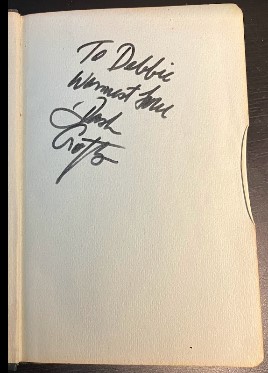
I loved the meetings, which were held in the homes of members. We prayed (okay, I did feel a little weird about that) but mostly just ate, laughed, and sang great songs. (Teach Your Children Well was a favorite.) There were no expensive trappings; the community affairs were administered by the Local Spiritual Assembly (LSA), a group of nine people chosen by the members. I liked that too. One person should not be the “be all and end all.” I was really involved–in the summer of 1973, I joined a group of fellow young Baha’is and took a bus to the Youth Conference in Oklahoma City! I still have my prayer book signed by Dash Crofts of the musical team, Seals and Crofts. It all just seemed so inclusive. Until they kicked me out.
By the fall of 1974, I started to see cracks in the wall. I went grocery shopping with one member and was shocked when he purchased a case of beer. Slowly but surely, the shine began to tarnish. In October, my Jewish friend from the neighborhood introduced me to one of her coworkers. Ok–yes, it was in a bar. I was gradually “slipping” in my own observance of the rules. By Spring 1975, Scott and I were cohabitating. And somehow the LSA found out about it. I received a very polite letter from the National Spiritual Assembly in Willamette, Illinois that, if I did not cease this violation of Baha’i law, I needed to immediately return my membership card. So, I did.
Religion played no role whatsoever in my life for the next decade. Scott, the son of a Methodist minister, had no use for religion. But we had his father marry us at the Yale Divinity School Chapel in 1983. It was a sweet, non-religious ceremony for which we wrote our vows.
Fast forward to 1989. Our eldest daughter, Caitlin, was ready to start school. Kindergarten in our town was only a half-day program, and I held a full-time job teaching. Our second child, Meghan, would be born in September; right at the beginning of the school year. I only had ten-weeks of maternity leave. My mother watched Caitlin while I worked. She was not looking forward to strapping a baby into a car seat to pick Caitlin up halfway through the day, especially in the winter. Our local Catholic school held full-day kindergarten. We decided Caitlin would attend St. Rita—just for her kindergarten year.
Four years later, she was still thriving at St. Rita’s, making better grades in Religion than her Catholic classmates! It was a little strange, explaining how this daughter of a Jew-ish mother and nonreligious father ended up at Catholic school.
The dearth of religious observance in our family was driven home the day I brought Meghan to St. Rita for her kindergarten interview. We were waiting in the school lobby for Caitlin to be dismissed for the day. Standing beside us was the school’s principal, Sister Pat. Hanging on the wall across from us was an icon of Jesus on the cross. Sweet shy, little Meghan, who usually was mute, pointed and said, in a voice loud enough to fill the entire lobby, “Who the heck is that?” Contrary to the school’s motto. “St. Rita, the Place to Be,” she did not get in.
Caitlin finished her education at St. Rita and then moved on to attend the public high school. She graduated from Hamden High just as Meghan began her freshman year there.
While Caitlin certainly had her fill of religion, I did have some regrets that Meghan’s religious education was non-existent. However, I figured if she ever felt curious, she could always explore it herself.
Somewhere in the early 2000s, I joined the Jewish Genealogy Society of Connecticut (JGSCT). My mother attended the monthly meetings with me for a while. I went for the genealogical aspect; Mom went because, in her words, “It’s nice to be with my tribe.” Sometimes I felt like a fish out of water (a throwback to my high school experience with MITY) especially when Yiddish terms were thrown around or people were eagerly discussing specific holidays and historical information. But I never felt compelled to join a synagogue or actively observe Judaism.
Our children married and had children of their own. There were no brisses and no baptisms. Christmas continued to be a major family holiday with no religious overtones. Easter was observed also as a secular holiday. (My mother loved celebrating Easter. She said she loved the colors!)
I’m comfortable, for the most part, simply acknowledging I am Jewish. I’m quite proud to be a member of the “tribe” who refuse to be wiped off the face of the earth. I did have a rather strong argument years ago with a Jewish co-worker who insisted being Jewish was just a religion, not an ethnicity. This was in the days before DNA. I wonder what she thinks now.
I’m not particularly spiritual, but I do believe (maybe hope is a better word) we “hang around” somewhere watching over loved ones after our deaths. I believe my ancestors have been guiding and protecting me and I also believe we live on through the influence we have on others. Plus, Jews don’t believe in Hell, so there’s that.
As I said earlier, the experience of writing the story of my family caused me to think more closely about my religious upbringing. As I age, having a sense of “belonging” has become more important. Perhaps, especially for my grandchildren, I will become more observant. As my husband is fond of saying, “Time will tell.”

