
Thank you for following my adventure at the 44th IAJGS conference this week. I almost thought about skipping some of my planned sessions today as my brain is on overload. But, I stuck it out and I’m so glad I did. Here’s a summary of my last day in Philly
European Holocaust Research Infrastructure Project (EHRI)
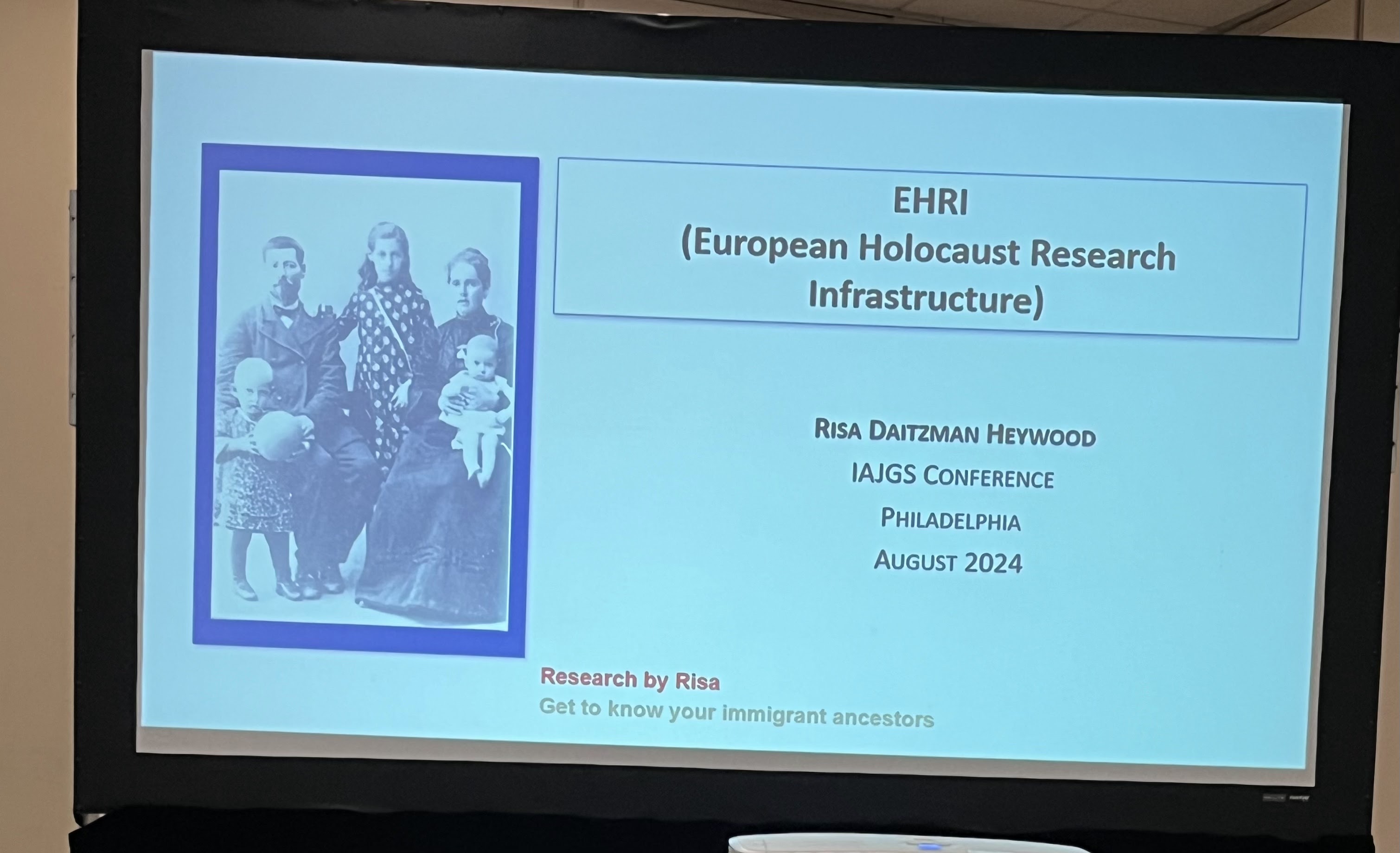
As you can imagine, I have done a lot of Holocaust research on a variety of sites. I almost skipped this session because I figured it was “just one more website…” I was wrong.
Risa Daitzman Heywood explained that the EHRI is not a repository nor a database. Rather, it is an international project founded by the EU in 2010. In fact, it never occurred to the creators that the site would be used for genealogical purposes, as its focus was to assist researchers and academics to find info available in other repositories. .
On the EHRI site, you can find a variety of self-paced on-line courses, research guides, podcasts, and many education offering all pertaining to the Holocaust. All free! One course, created by Yad Vashem, The Holocaust through the Perspective of Primary Sources sounded especially interesting.
The site can be a tricky to use, but you may find sources you never knew about and wouldn’t ever find on your own. An example is the EHRI Geospatial Repository. That site includes various maps, including some concentration camps, changing borders, and one of special interest to me: Last addresses in Vienna of Stateless Jews from the “Stadionaktion” in 1939. I haven’t had time to review it yet but I certainly plan to explore the entire website when I have more time.
Due to technical issues, Risa was unable to show us the video on YouTube explaining the organization’s mission. Click HERE to view it, if you are interested in learning more. It’s definitely a resource I will make use of.
Turning Your Documents Into Dramatic Tales
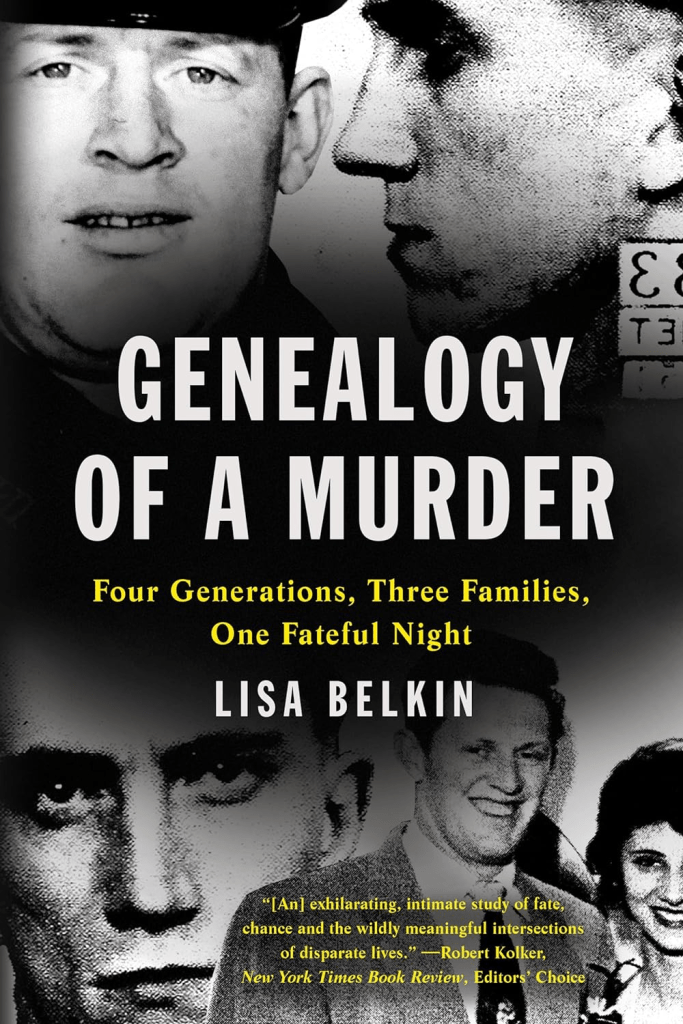
I decided to take a break from Jewish Research to put on my author’s hat. This session was presented by Lisa Belkin, author of the book Genealogy of a Murder. I’m always interested to hear what strategies other authors use and the program description for this session sounded like the author might be a kindred spirit, writing creative nonfiction.
It was not exactly what I expected but still very interesting. Lisa, a professional journalist, described how she came to write a story she was told by her stepfather, who had been a physician at a state penitentiary in Illinois. He befriended an inmate, eventually helping to secure his release, The inmate ended up in Connecticut where he eventually became involved in the murder of a politic officer.
I would have liked to hear more about her writing process. In fact, one of the members of the audience specifically asked how she could take all her research and turn it into a story. Lisa gave the usual answer: Just start writing. Well, of course, that true. But not what the woman wanted. Too bad I wasn’t able to give MY talk (maybe next year!!) I looked to find the woman at the end of the session so I could tell her to reach out to me, but she had already left.
Lunch Break!!
Scott and I had a very pleasant lunch break, extended, since my 2 p.m. session was cancelled. We went to lunch at the Victory Taproom. It was a beautiful day, so we sat outside on the rooftop patio. So pleasant and relaxing.
We took a leisurely walk around the area checking out the Saints Peter and Paul Cathedral and a couple parks. We stopped into the Free Library of Philadelphia just as a tour began, so that was pretty cool.


AI-Assisted Genealogy: The Family History of the Future

I already heard Daniel Horowitz give a similar talk at RootsTech in March. But, he always makes me laugh and I always learn something new about what is happening at My Heritage. Today, I didn’t learn about any new technologies but I enjoyed being reminded about all the fantastic tools available on the My Heritage website.
I think my favorites are the ones related to photos.

Photo tagger helps you quickly tag the same person across the site, saving you tins of time
Colorize brings old black and white photos to life.
Enhance does a really good job of improving photo quality.
Animate brings your ancestor to life with movement.
Deep Story allows your ancestor to “tell” their own story by speaking the words you choose for the story.
AI Time machine is just silly fun. Using the picture of one person, you can see what they may have looked like during different periods of time in history.
Artificial Intelligence (AI) is the simulation of human intelligence processes by computers
Daniel Horowitz, IAJGS 2024
My Heritage now has its own newspaper subscription site, Old News. What sets it apart from others is the ability to search for articles by any word in an article. Also great is the ability to get a pretty accurate OCR transcription, which you can then copy and paste into ChatGPT. From there you can ask ChatGPT to create a summary or extract just the facts from the article. Wish I had that ten years ago when I was transcribing hundreds of newspaper articles for the book about Scott’s great-grandmother!!
There is so much more available to help you with your research. All are free to non-members so check them out. Subscribe to the blog at https://blog.myheritage.com/ in order to stay informed.
THE LAST SESSION: Specialized AI Tools and Custom GPTs for Genealogy

I almost felt like I was back at RootsTech since this session was led by Steve Little, who I also saw there in March. One might think a person as well versed in AI as Steve might be over the heads of us newbies. Nope. He is clear, concise, helpful, and funny!
These tools make mistakes. You are the human in the loop.
Steve Little, IAJGS 2024
I could write an entire article with all the information Steve shared in this presentation. Because it is 9 p.m. I am just going to touch on highlights. If you are interested in learning more, consider joining the Facebook group, Genealogy and Artificial Intelligence where Steve is an active member and freely shares information.
I’m a member of the group and, after today’s session, I admitted to Steve that I have ignored all the discussions about making custom GPTs. I assumed it was some complicated programming that I wasn’t capable of understanding. I couldn’t have been more wrong.
A CustomGPT is simply a prompt that you create like any other prompt. The difference is, if you have a paid ChatGPT account, you can save the prompt and tweak it to perform tasks so you don’t have to recreate the wheel every time you want to perform that task. Steve showed us examples of custom GPTS he created. If you want to (and Steve does!) you then can share the tool with specific people or make it public so everyone can use it.
CustomGPTs are like having your own Swiss Army knife for genealogy – your own tool kit.
steve little, IAJGS 2024
Examples of CustomGPTs Steve created:
Steve’s Fact Extractor: pulls facts out of newspaper articles
Steve’s Fact Narrator: Takes list of facts and turns it into a story narrative
Steve’s Photograph Analysis: describes a photograph in detail and also creates a caption
After learning how easy this is to do, I think it might be time to jump in and get the paid version of ChatGPT. (I might write a post about this in more detail if anyone is interested.)
And then – it was over. The 44th IAJGS is now history, Thank you to all who helped in any way to make this event possible. It was a great week. Next year – Fort Wayne, Indiana!!
 Who We Are and How We Got This Way
Lisa Belkin’s book is not to be missed if you’re interested in how family history resonates through the generations. Well written and poignant.
LikeLike